
Tips for Fine Tuning Your B2B Strategy - Issue #1
John Bernardi • July 27, 2019
Support Your Strategy with a Portfolio of Smart Tactics

Smart
business leaders continually update their portfolio of ideas for elevating some
aspect of their business to the next level.
At the right time, they implement the right idea(s) that eliminate
status quo thinking within their firm. Does your portfolio include each of the
following “smart tactic” categories? From
the many ideas available, I offer one new idea for you to consider in each
category.
- Always be looking for ways to improve the customer experience
.
Take an inventory of all of your touch points [pre-sale thru post-sale]. Rank them in order of customer impact. Diligently upgrade them one at a time.
- Continuously innovate
. Add recurring revenue sources to your product mix [maintenance, certifications, support, licenses, training, upgrades, etc.]
- Apply intuitive sales competencies
for reducing buyer risk instead of lowering your price. Create a unique value proposition
as the essence of your executive summary for each sales proposal.
- Implement account-based marketing
tactics in order to generate repeat business, new applications and referrals. Stay in touch with past customers with an effort based on the A, B, C rating you apply to each. I coach my clients to develop Most Valuable Customers[MVCs].
- Indirect marketing
tactics will optimize lead generation. Be discovered by company personas who are attracted to the specific brand UVPs
that you have created for them. I target two personas.
- Partner with complementary vendors
who enable you to offer total solutions to customers. Solidify the partner relationships by developing them into a bidirectional referral source.
- A strong
business acumen
sets your employees apart from competitors. Translate income statement and balance sheet basics to the needs you’ve researched for accounts and contacts.
- Predict success
. Monitor leading indicators in real time [ lead generation and sales funnel health].
- Improve success . Learn from lagging indicators [close rate, loss analysis, deal size, sales cycle length, average discount, # products per deal and the # of leads required to find a winnable opportunity].
Have you’ve
tried any of these ideas? Did they produce
significant results? Would you be
willing to share other ideas that have worked successfully for your business?

How to Influence a Sale Before You Make the Sale
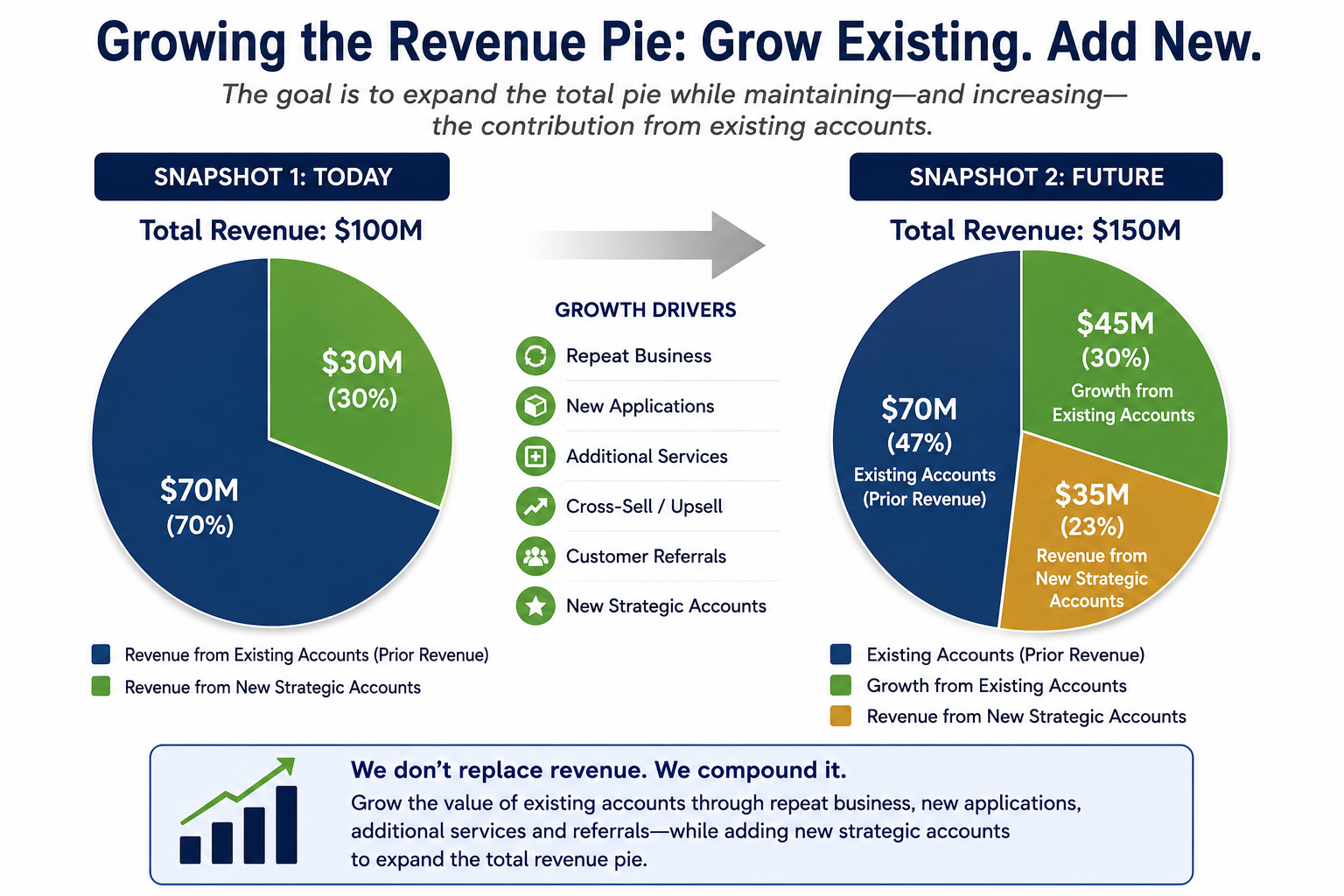


But Not Every Sales Opportunity Creates the Same Level of Value

Organization charts rarely reveal how strategic decisions are actually made.

Most companies focus on filling their marketing and sales funnels with opportunities. Sustainable growth, however, often comes from a handful of transformational wins that open new markets, create new capabilities, and generate years of follow-on business. I call these Golden Spike opportunities . The inspiration comes from history. In 1869, the ceremonial Golden Spike joined the Central Pacific and Union Pacific Railroads at Promontory Summit, Utah, completing America's first transcontinental railroad. That single event connected markets, accelerated commerce, and created opportunities that had never before existed. Eastern manufacturers gained access to western markets, western resources flowed east, and competition fueled innovation. Great companies create their own Golden Spikes . A Golden Spike sale is not simply a large order. It is a strategic opportunity that helps a company expand into a new market, launch a new service, establish a new partnership, or significantly deepen its position within an existing market. Often, it involves applying existing capabilities in slightly different ways to solve bigger customer problems. In my experience, Golden Spike opportunities are typically three to five times a company's average deal size while also meeting or exceeding gross profit objectives. They may come from direct or indirect selling channels and do not necessarily originate with large companies. Finding and winning these opportunities requires a different mindset than managing day-to-day sales activity. Successful Golden Spike hunters possess: Patience and a long-term perspective. A disciplined research process. Strong relationships with connectors, mavens, and key influencers. The ability to identify an internal coach who wants them to succeed. The skill to navigate the business, technical, and political dimensions of complex sales. Excellent time management and peripheral vision. Golden Spike hunters keep an ear to the ground. They build relationships long before a buying cycle begins and look for opportunities that competitors never see. So, how does this differ from Target Account Development ? Target accounts are organizations that closely match your ideal customer profile and can provide recurring business over time, including the occasional Golden Spike opportunity. Developing target accounts requires a focused direct-selling strategy designed to build relationships and generate a steady flow of business. Golden Spike Hunting is different. Target Account Development answers the question: "Who should we pursue?" Golden Spike Hunting answers the question: "What transformational opportunities should we create and win?" The two strategies complement one another, but they are not the same. One identifies the right organizations to pursue. The other seeks the opportunities that can materially change the trajectory of the business. As you think about your own growth strategy, consider these questions: What type of Golden Spike interests you—an existing product in an existing market, an existing product in a new market, or an entirely new product or service? How long does it typically take to uncover a Golden Spike opportunity? How much time is required to nurture and close one? How many opportunities must be found to win one? How many Golden Spike does your company need over the next three to five years? How much time and organizational commitment are you willing to devote to finding them? Most companies have a target account strategy. Far fewer have a Golden Spike strategy. If your long-term success depends on winning a handful of game-changing opportunities, perhaps it's time to bump your targeting efforts up a notch. Happy Hunting.

Win/Results is a Power Base Selling concept. The strongest sales conversations connect the two. Win = the personal benefit to the buyer as an individual Results = the business benefit to the organization Results = Company Impact - rational business case with organizational outcomes Increased revenue Lower costs Higher productivity Reduced risk Improved retention Higher margins But buyers rarely make a decision based only on company outcomes. They’re also subconsciously asking: “How does this affect me; will this make my life easier?” “Will I look smart; will this help my career?” “Will this reduce pressure; will this protect me from failure?” Win = Personal Impact - emotional and career dimension of individual motivations Recognition Promotion potential Less stress More control Political credibility Saving time Avoiding embarrassment Looking strategic to leadership Hitting bonus targets Job security


A scientific analogy provides a unique concept for guiding your business to its next level.